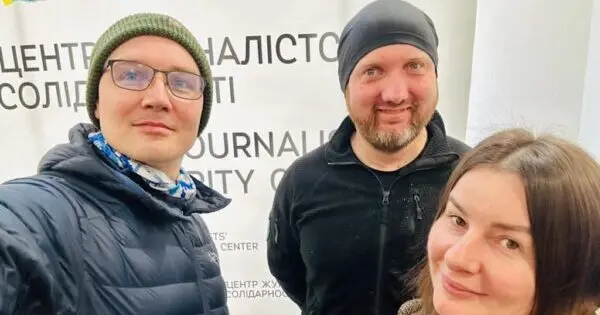
By Scott Douglas Jacobsen and Volodymyr Pavlov (Translator, English-Ukrainian)
How do Ukrainian journalists understand superstition, grief, and mental health during wartime?
“Supernatural belief for us is support for mental health, while for them it is a search for a solution, as if someone else will do it for them.” – Anna Chernenko
Anna Chernenko is a Ukrainian journalist working in Kharkiv, reporting on wartime conditions, media transformations, and civilian life under threat. She has documented the shrinking journalism sector, risks faced by reporters, and evolving safety practices. Her work reflects the human and professional impact of sustained conflict on Ukraine’s media landscape.
Scott Douglas Jacobsen interviews Anna Chernenko and Volodymyr Pavlov about wartime journalism in Ukraine, focusing on how religion, superstition, and supernatural belief function as emotional supports amid grief, fear, and uncertainty. Chernenko contrasts Ukrainian coping with Russian passivity, while warning about scammers exploiting vulnerable people. Pavlov adds field-reporting examples and reflections on depression, randomness, and survivor’s guilt. The discussion links media ethics, psychology, trauma, and civic resilience under war.
Scott Douglas Jacobsen: So a sociological question: on obscure and subtle social and psychological phenomena, do levels of religious, superstitious, and supernatural belief sometimes change or intensify in both Russia and Ukraine during war? On the Ukrainian side, some of this is used for coping with grief and for resilience. It provides routine. On the Russian side, it seems more like superstition. On the Ukrainian side, I understand it differently.
There is a need for a sort of anchoring of oneself. To have empathy for an individual who is coping with the death of someone and using this to cope is not to endorse the supernatural idea. I do not believe we have evidence for the supernatural. However, I understand that, in the short term, these coping mechanisms can be healthy. In the long term, they may not necessarily be, as a personal opinion.
It functions as an emotional anchor for people. I am a humanist and a scientifically oriented person, so I see no evidence for the supernatural. For someone to believe they will be reunited with their loved one in the afterlife, I understand the comfort that belief brings. However, empathy for the person does not in any way endorse the empirical claim.
In Ukraine, I understand there is a significant level of religious belief and superstition both before and during the war. There are interesting dynamics in both Russia and Ukraine regarding the effect of war on supernatural belief. So, the question is interesting, and I sometimes think about it:
What are your thoughts about the divergences between Ukrainian and Russian society and the use of superstition and supernaturalism to cope with and/or comprehend the war, to give it meaning and structure? These are non-scientific beliefs, and they may be false, while still providing a framework for coping with tragedy and death if believed. Many Ukrainians and Russians are religious believers and/or harbour and practice superstitious beliefs.
Anna Chernenko: There is always something close to the supernatural. Not everyone believes this, but during the war, this belief has been preserved and, in some cases, strengthened.
We Ukrainians have always had some inclination toward belief in the supernatural and religion. Of course, not everyone. But during the war, this belief has become more widespread, including beliefs in the supernatural. This is a way to avoid emotional stress from difficult-to-deal-with problems.
Ukrainians have been attracted to belief in the supernatural and religion, though not everyone in the population has been. Since the beginning of the full-scale war, belief in the supernatural has increased and intensified. This often helps some people deal with emotional stress.
This helps the psyche. This is the first part, a small part. So, we Ukrainians have always tended to a certain belief in the supernatural and religiosity. Of course, it does not apply to the entire population. But with the onset of the full-scale war, this belief in the supernatural intensified. I often think about this. For some people, it is a way to cope with certain emotional burdens and support the psyche.
I know a few people who ask certain mystical individuals what they should do. Emotionally, when people are searching for answers, there are also frauds, of course, and certain demands for money from people in such emotionally vulnerable times.
I personally know several people who, from time to time, ask questions of such mystical persons. I remember them asking when the war would end. A person needs to know a certain date, or more precisely, to believe in a certain end, and then it becomes easier for them to bear all the burdens they have now because of the war. People are looking for missing persons, and finding what they are looking for is also a form of emotional relief. There is also fraud here, of course, as well as corruption and the extortion of money from people. This affects those who are emotionally vulnerable at such a time.
Jacobsen: Yes, one hundred percent.
Chernenko: As for the differences between Ukrainians and Russians, I know that, before the beginning of the full-scale war; there was a strong belief in the supernatural in Russia. It was also a business. In Ukraine, there were also some fluctuations, though not as significant. The main difference is that we, emotionally, look for support, while they look for a solution. They may hope that something supernatural will act on their behalf. This is manifested at different levels. They can protest against what is happening in their country. In our mentality, we also protest.
Accordingly, supernatural belief for us is support for mental health, while for them it is a search for a solution, as if someone else will do it for them. That is my idea. They are simply looking for a solution, so that someone can do something for them, and this was the case before. We are looking for support for our nervous system. This is manifested at different levels. For example, Russians either fail or have stopped protesting against certain things. They look for a quick solution in the supernatural and religion, so as not to act on their own. They are looking for a simple solution in the supernatural and religion. We are looking for support.
Jacobsen: Which topics are taboo in Ukrainian journalism?
Chernenko: It is a complicated question.
Jacobsen: Some reactions have been strong. Earlier, I avoided these topics. Now, I take a more academic approach. This is data. It tells me something about the country’s pulse. So I carefully ask about superstition and religion. I see no evidence for the supernatural. However, in war, people cope in different ways, and that calls for empathy. At the same time, one does not have to abandon empirical truth.
Sometimes there is no hope. Objectively, people die, and from an empirical standpoint we can verify death, but claims about an afterlife remain unverified. There is no broadly accepted empirical evidence in favour of an afterlife, which does not by itself constitute a disproof. At the same time, when a person is suffering, both realities can be acknowledged. These are not incompatible.
Chernenko: I cannot say that religion is like that. I cannot explain what would be taboo for journalists. It is a deep immersion in life. I understand what you are talking about, not to offend, but we do not have such taboos. I can tell you clearly: there is no clear taboo. Sometimes I work with a photographer from the United States. She said, “Never use that word.” It is like saying, “It is calm here” or “It is quiet here.” After that, something always happens.
Jacobsen: I see.
Chernenko: It is not a taboo, but I do not think religion or the supernatural is taboo if we speak about it as a topic of work in journalism. It is more often presented as the subject’s personal opinion. Many shows directly ridicule people’s trust in scammers connected with the supernatural. It would certainly be taboo to delve into the personal life of the deceased or their family if we are creating materials.
Do journalists believe in the supernatural? They are more likely to believe in mild superstitions and premonitions.
Jacobsen: What superstitions? What premonitions?
Chernenko: Sometimes there is a certain fear of going somewhere, for example, to the frontline, because something might happen. But I do not believe in the supernatural. I tell myself not to rely on that. Sometimes there are situations. I worked with a foreign team in Donbas, near the Serebryansky Forest. We were supposed to visit an artillery position and meet with a press officer. It was a foreign team.
Volodymyr Pavlov: It was a fairly large media group. We were in two cars. We took a route, and a soldier guided us as we began our trip. The first time, the second car in our convoy missed the road in the village before the forest. The second time, the car got stuck on a pontoon bridge.
The third time, we were stopped again. Our second car got stuck on a wooden bridge, like the kind made from cut logs. We found soldiers, and they helped us remove the car. About fifteen meters later, the same car got stuck again in the same way. The soldiers laughed, but they helped us.
Then, around the sixth or seventh time, the rain started. The roads became very muddy. If we had continued, we would have gotten stuck, so we cancelled the filming.
Chernenko: So, it is not supernatural, but something stopped us at least six times. I am lucky so that nothing will happen. Nothing has happened yet.
Jacobsen: We all, or most of us, understand that not every bullet that is fired or missile that lands hits its intended target. It is sometimes random, and people are killed.
Yet, similarly, we sometimes do the opposite in everyday life during war. We think that everything must have meaning, that the person deserved it, or that we are somehow excluded from the rules of war.
Chernenko: Not every rocket that flies has a specific target. Sometimes it hits randomly. Do not think that you deserve it. Every human deserves to live as long as possible. Unfortunately, we have seen many children killed who clearly deserved to live many happy years.
Jacobsen: For a person who thinks critically, the idea that they “deserve” such events is depressing.
Pavlov: Yes, sometimes older people think this way, that perhaps they deserve what is happening, or that it had to happen to them. But in most cases, this is a symptom of depression. People who can think critically understand that this idea is not correct.
Jacobsen: Yes, and people also experience survivor’s guilt. Some will think, “Why me, why me?” Others, with survivor’s guilt, those who survived when loved ones or others close to them died in the same event, may think in more rational terms.
Chernenko: That is an interesting topic. It is complex and makes your mind work from different perspectives.
Jacobsen: We know statistically that some percentage of the population develops cancer over the lifespan, even children. So why not me? If you get cancer, statistically, it happens.
Chernenko: We hear about this from the military, from those who lose their comrades and friends. This is not about the supernatural or religion; it is about conscience and the psyche. Many Ukrainians needed psychological support after the beginning of the full-scale war. This is about our nature, about emotions and mental health.
Pavlov: In 2013, I worked with Mika Volvend’s team in France. There were 55 or 56 people, and only two spoke French. We worked all day and returned around 9 p.m. to where we were staying. We went to McDonald’s because it was the only place open where we could buy dinner at night.
For 55 people, they ordered everything. It was wild. Big portions, big orders. It was much easier then.
Jacobsen: The important thing now is that not everyone needs to speak another language, but everyone can communicate with technology and access to the internet.
Chernenko: We often see this feeling of guilt as journalists when we film scenes of tragedy, when someone in a family dies. We hear about it from soldiers who have lost comrades and friends. This is not about the supernatural or religion. It is about conscience, the psyche.
Ukraine already needs psychological support and will continue to need it after the full-scale war ends, because these issues must be addressed. It is not about the supernatural, but about emotions and mental health.
Jacobsen: If we are dealing with psychological support and mental health, this leads to the question of why people turn to religion and the supernatural.
We know that in some societies with strong social infrastructure, such as daycare, healthcare, pharmacare, free education, and reduced costs for post-secondary education, the number of religious believers often declines on average, though this is a correlation-heavy pattern rather than a simple law. Among those who still believe, adherence to religious tenets and attendance at institutions such as synagogues, temples, churches, and cathedrals also can decrease. Even among believers, commitment is often less intense. For example, Sweden has a large proportion of the population with little or no active religious affiliation, and Pew has reported that 52% of adults in Sweden are religiously unaffiliated.
The idea of state atheism, as in the Soviet Union or in contemporary China, is another form of official state ideology, but one based on political dogma. It reflects a similar structural dynamic from a political perspective.
When these indicators decline in contexts with strong social support, it raises questions about Ukraine during the war. People may be turning to faith and superstition because there are insufficient psychological and material supports to help them cope empirically and naturally.
In this sense, faith and superstition can function as placeholders. This is why one can have empathy for individuals as a subjective reality while maintaining a scientific perspective as an objective framework. In the short term, these mechanisms may be understandable and even helpful; in the long term, they may not necessarily be.
Chernenko: This raises the question of Ukraine during the war. People may turn to belief when psychological support is insufficient. To address individual challenges, people need to understand reality. Faith and self-confidence can be useful in this context.
We have some volunteer and faith-based programs that aim to support people’s mental and psychological health. But we do not have a strong culture of going to psychologists. That is why, under these conditions, we have a great deal of religious support and supernatural support.
We have some volunteer and state support, but it is not enough. Secondly, we do not have a culture of seeking help from psychologists. We have a history in which seeking psychological help was not common, and that is partly because of the Soviet Union.
There is also the issue that when a person turns to a psychologist, they are sometimes laughed at. All of this has stayed within us. There is no culture of going to a doctor for issues such as depression. This was also seen as abnormal. Only now are we realizing that this kind of support is normal. In this sense, religion can function as a psychological support.
I want to give an example. Once we were in a religious temple. Among the people who went to the priest was a woman in the last months of pregnancy whose husband had died. Religion helped her. Why did she not go to a psychologist? She did not want to, she did not know where to go, and she did not trust it. But religion was available.
So, during the war, any way to escape problems may seem normal. But there are also harmful manifestations, such as people being deceived by charlatans. This is the other side of the supernatural, unfortunately, and their number is increasing. I have a friend who visited a kind of service. I was there too. It was with tarot cards. Before, I did not think much about it, because many people support these beliefs. But after this, I began to notice that many people do this. We have too many people who believe in the supernatural.
We do have certain volunteer and state programs, but this is not enough. Indeed, we do not have a culture of turning to psychologists. The history of a person seeking a psychologist is still rare. There are many anecdotes about people who turn to a psychologist and are ridiculed, especially men. Men often reinforce this attitude among themselves.
We have only begun to overcome this within ourselves. There is also no strong culture of turning to a doctor for medication such as antidepressants. For a long time, this was considered abnormal. Only now are we moving toward the understanding that such support is normal, and religion often fills this gap.
Jacobsen: Yes. In Canada, it is similar. In America as well. Certain figures, such as tarot readers, often fill it.
Chernenko: I want to give one example. Once we were filming a religious holiday in a temple, among the people who regularly went to the priest was a woman in the last months of pregnancy. Her husband had died. Religion helped her cope with the grief. Why did she not go to a psychologist? She did not want to, she did not know where to go, and she did not trust it.
But religion was her support at that time. During the war, many methods may seem normal. If you escape from problems, you may avoid a psychological breakdown. But I want to return to the fact that there are many cases of fraud. Unfortunately, scammers profit from people. This is connected to belief in the supernatural, and the number of people holding this belief is increasing.
Jacobsen: What was happening with scammers before 2014? How has this changed since 2014 and 2022, especially now? What types of scammers are there? What is the scale? How do you combat it?
Chernenko: It is not only about faith and the supernatural, but also about strange things, magic, voices of saints. I have spoken to such people. As far as I know, this is not a crime under the law. I watched a video about one such person. This person was extremely disturbing.
But the internet community often ridicules this, making videos against scammers. Scammers take advantage of people’s vulnerability during the war. When the war ends and a few years pass, the situation may improve.
Jacobsen: Yes. Even in the United States, it is paradoxical. It is a country with advanced technology and scientific research. At the same time, there is a significant level of religious belief and fundamentalism. This has influenced the country politically.
Even if the war ends and conditions improve, there is no guarantee that these patterns will disappear. Most societies retain some level of these beliefs. The most realistic outcome in the near and medium term is a reduction or moderation of such tendencies.
Unfortunately, these beliefs can be exploited. Some people refer to such actors as “grief vampires” because they take advantage of people experiencing loss, or of those who do not fully understand that we live in a natural world. The natural world is not known to operate according to human concerns or moral desert; people care about people.
Chernenko: I like this phrase. When we talk about these issues, about the psychology of people, there is such an idea.
This war will end, and this level will decrease. It is logical. Right now, people are searching for someone, but over time, this will change. As was said, the most one can hope for in a reasonable, medium-term perspective is a decrease in these beliefs and behaviours. Unfortunately, some people take advantage of others through grief. Some call them “grief vampires.”
Jacobsen: There is also ignorance of the fact that we live in a natural world. However, I do not agree that the natural world does not care about you. That cannot be said.
Chernenko: We now have many emotions and a lot of stress. Why did I say that belief will decrease after some years? People are searching for their missing loved ones. People are trying to survive grief, and in a few years, they will return to more stable lives. Then all of this will be pushed further away from everyday life. This has already happened, for example, after the Second World War.
We will survive this. The next generation will experience less of it and live in a different world, more focused on ordinary life, games, and films. This indicator will decrease. I had not heard the phrase “grief vampire” before. It is striking. Of course, such people will remain, but in smaller numbers.
I still believe the number will decrease. This is logical because our society is quite educated. Many people are dealing with emotions and stress. That is why I said that trust in scammers and in the supernatural will decrease. A few years after the war, people will still search for missing loved ones and try to cope with grief, but eventually these experiences will recede from daily life.
We have already seen this after the Second World War. The next generations will live differently, in a calmer world. This indicator will drop significantly. The phrase “grief vampire” is interesting. I had not heard of it before. Such people will remain, but fewer than now.
Jacobsen: The phrase “grief vampires” appears in some online atheist, non-religious, and humanist commentary circles. It refers to individuals who consciously take advantage of people in emotionally vulnerable states. It is analogous to certain structured support movements, such as those that emphasize submission to a higher power. Historically, some of these movements had explicit religious foundations.
Alcoholics Anonymous, for example, grew out of the explicitly Christian Oxford Group, but AA later adopted the broader formulation “God as we understood Him” rather than a specifically Christian test of belief. This can serve as a way to shape belief at a vulnerable moment.
In North America, the use of vulnerable moments in life for social and financial gain is well documented and has a long and troubling history. Based on a principle of general human behaviour, there is no reason to think this would not appear in other parts of the world, though in different forms. War is a context in which people are deeply vulnerable, so those who exploit grief will emerge more visibly.
Chernenko: A certain percentage of people who believe in the supernatural and who take advantage of others’ trust will remain. Such people exist in society. The task of society is to help individuals leave such environments, these groups or circles where people are exploited. This is important.
They will remain, but there are more of them now. Later, there will be fewer. They will gradually move out of everyday life. However, any country that has gone through war will need time to return to normality.
A certain percentage of people who believe in the supernatural and take advantage of others will certainly remain. Society should help people leave organizations and groups that exploit human vulnerability. This is important.
These individuals will always exist. There are more of them now than there will be later. Over time, life will become more stable again, but returning to normal conditions after war will take a long time for any country.
Jacobsen: Thank you very much for the opportunity and your time, Anna.
Image Credit: Scott Douglas Jacobsen.